Biography audiobooks transform intimate life stories into immersive listening experiences, letting you absorb the triumphs, failures, and defining moments of fascinating people while commuting, exercising, or simply relaxing at home. Unlike fiction, where dramatic narration can feel overdone, biographies thrive in audio format because skilled narrators bring authenticity and nuance to real lives, turning years of research and interviews into what feels like a personal conversation about someone remarkable.
The format works particularly well for biographies because these books often span decades or even centuries, weaving complex timelines and multiple perspectives that can feel dense on the page. Audio narration guides you through these intricate stories with pacing and emphasis that highlight what matters most. I discovered this firsthand during a road trip through Scotland last year, when a 22-hour biography kept me completely absorbed through winding Highland roads, the narrator’s voice making a 19th-century explorer’s journal entries feel as immediate as a podcast.
What makes biography audiobooks especially compelling in 2026 is the growing sophistication in production quality and narrator selection. Publishers now carefully match voices to subjects, sometimes featuring the authors themselves reading their own research or family members sharing personal stories. This attention to detail creates an emotional resonance that silent reading rarely achieves.
If you’re new to the format or wondering whether biographies translate well to audio, the short answer is they excel at it. The key is understanding what to look for: narrator credibility, production quality, and whether the subject matter suits extended listening sessions. Some platforms currently offer promotional access (Audible’s Prime member deal runs through October 27, 2026, offering four months at $0.99 monthly plus a $20 credit), making this an ideal moment to explore the category.
This guide will help you understand why biographies work so well in audio, how to choose titles that match your interests, and where to find the best listening experiences available today.
What Makes Biography Audiobooks Different from Reading

When you press play on a biography audiobook, you’re not just absorbing facts about someone’s life, you’re inviting a performance into your day. The narrator becomes your guide through another person’s story, and that shift changes everything. I remember the first time I listened to a memoir while walking through Edinburgh’s Old Town, the author’s voice in my ears as I traced streets they’d once known. The experience was layered in a way reading never quite achieved, as if the storyteller was there beside me, sharing secrets meant just for my ears.
The narrator’s interpretation adds dimensions that silent reading can’t replicate. A skilled voice actor can infuse a historical figure’s letters with longing, deliver a revolutionary’s speeches with the passion they must have carried, or navigate the complexity of a flawed subject’s choices with nuance that makes you reconsider your assumptions. When an author narrates their own memoir, you hear the pauses, the slight catch in their voice when recounting difficult moments, the warmth when they speak of people they loved. These aren’t embellishments, they’re the emotional truth of the story made audible.
There’s also the practical magic of being able to fold someone’s entire life into the rhythm of your own. Biography audiobooks travel with you, into the car during your commute, onto the treadmill, through the grocery store, beside you while you cook dinner. A 600-page biography that might sit on your nightstand for months becomes something you can finish in a week of everyday moments. This isn’t a lesser way to engage with the material. It’s simply different, and for many of us, it means we actually experience books we’d otherwise never get to.
The theatrical quality of well-produced biography audiobooks deserves attention too. Sound design, subtle music cues, and the pacing choices narrators make transform the listening into something closer to a one-person show than a book report. When you’re hearing about Churchill’s wartime speeches, the narrator’s delivery can echo that original urgency. When following an explorer’s journey, the voice can carry the exhaustion and wonder of discovery. Reading gives you the story. Listening gives you a performance of that story, and sometimes that performance unlocks understanding that words on a page keep at arm’s length.
Who Narrates Biography Audiobooks (And Why It Matters)
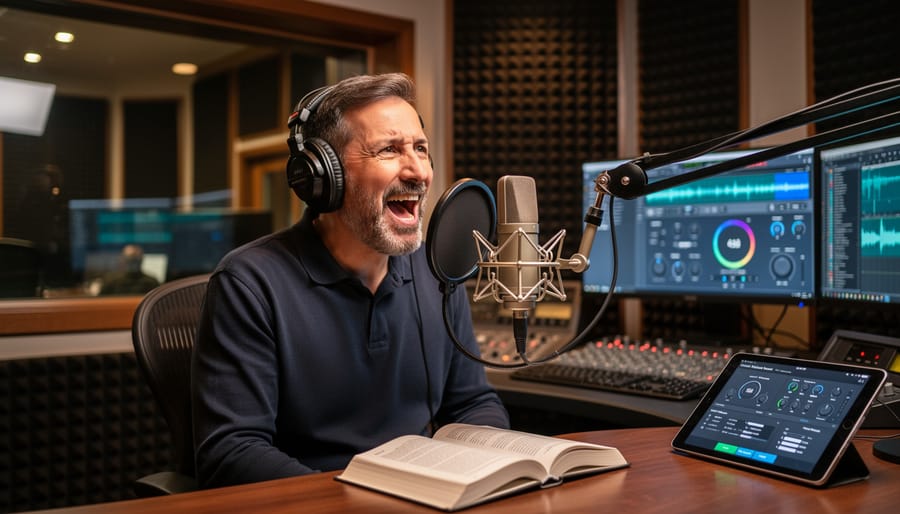
The voice you hear matters more than you might think. I learned this the hard way after downloading a highly-recommended political biography, only to abandon it three chapters in because the narrator’s flat delivery made a fascinating life story feel like a tax document. The same week, I tried Michelle Obama’s “Becoming” read by the author herself, and suddenly understood: the person behind the microphone shapes the entire experience.
When authors narrate their own memoirs, you’re getting something unrepeatable, their actual voice, their natural pauses, the places where emotion breaks through. Trevor Noah’s narration of “Born a Crime” adds layers the text alone couldn’t capture, switching between accents and languages that bring his South African childhood vividly to life. There’s an intimacy in hearing someone tell their own story, stumbles and all, that professional polish sometimes smooths away.
But biography audiobooks come in several narrator forms, each serving different purposes:
- Author-narrated memoirs that offer authentic voice and emotional connection
- Professional voice actors who bring vocal range and stamina to lengthy historical biographies
- Celebrity narrators whose recognition factor and interpretive skills enhance the subject’s story
- Multi-voice cast productions that assign different narrators to different characters or time periods
- Subject-narrated autobiographies where the person tells their own life story directly
Historical biographies typically rely on skilled professionals who can sustain a thirty-hour narration without their voice giving out. Someone like Simon Vance or Juliet Stevenson brings a Shakespearean training to bear, they understand pacing, know how to differentiate quoted dialogue from narrative passages, and can pronounce unfamiliar historical names without breaking stride. When you’re listening to a biography of Churchill or Cleopatra, you need someone who can inhabit multiple perspectives across decades without sounding like they’re reading a Wikipedia entry aloud.
The choice becomes part of the art form itself. A celebrity narrator reading about a cultural icon creates an interesting dialogue between two public voices. A subject narrating their own autobiography, when health and time permit, gives us something archival, Barack Obama reading his presidential memoir, for instance, becomes a historical document in its own right.
Sample the first chapter before committing. Most platforms let you preview, and five minutes will tell you whether this particular voice will carry you through someone’s entire life story.
Types of Biography Audiobooks Worth Exploring
Memoirs and First-Person Narratives
Memoirs stand apart in the audiobook world because there’s something irreplaceable about hearing a life story in the voice that lived it. When authors narrate their own memoirs, you’re not getting a performance, you’re getting direct transmission. The pauses carry meaning. The emphasis reveals what still matters decades later. That slight crack in the voice when recounting a painful moment? You can’t script that kind of truth.
This first-person intimacy transforms memoir audiobooks into something closer to sitting across from someone over coffee while they tell you about the hardest year of their life, or the discovery that changed everything. The conversational quality makes even heavy subjects feel approachable. You hear the author’s humor in their timing, their regional accent grounding you in their world, their breathing reminding you this actually happened to a real person.
The memoir umbrella stretches wide. Celebrity memoirs often surprise listeners with unexpected depth, actors and musicians revealing the machinery behind public personas. Survival stories gain visceral power in audio, whether they’re about wilderness expeditions gone wrong or navigating illness. Coming-of-age memoirs capture the texture of growing up in specific times and places, from immigrant experiences to small-town America to finding identity against resistance.
What ties them together is intimacy. Reading a memoir engages your imagination; listening to one delivered in the author’s own voice feels like being trusted with something private. That shift changes how the story lands.
Historical Biographies and Lives of Public Figures
Historical biographies in audio format offer something remarkable: they collapse the distance between past and present, letting you hear Churchill’s war speeches analyzed by a narrator who captures both the gravity and the human complexity, or follow Marie Curie’s scientific journey through a voice that makes early 20th-century Paris feel immediate. The difference between history and dramatization becomes beautifully blurred when a skilled narrator brings archival letters, diary entries, and historical accounts to life without sacrificing accuracy.
What makes these audiobooks work is the narrator’s ability to provide context without lecturing. A good historical biography narrator can shift tone when moving from describing a political decision to quoting the figure’s private correspondence, helping you track both the public persona and the private person. I listened to a biography of Frida Kahlo during a road trip through the Southwest, and the narrator’s pacing made the Mexican Revolution feel as vivid as the desert landscape passing by my window.
Political figures, artists, scientists, and cultural icons each demand different narrative approaches in audio. Biographies of leaders benefit from narrators who can convey the weight of consequence. Artist biographies shine when narrators understand creative process and cultural movements. Scientific lives need voices that make complex discoveries accessible without dumbing them down. Many of these titles appear on best nonfiction books lists precisely because audio performance elevates already excellent writing into an experience that feels like having a knowledgeable friend explain why this person mattered, and still does.
Group Biographies and Collective Stories
Group biographies offer something special in audio format, they let you experience multiple voices and perspectives in a single listening journey. These audiobooks might follow a family across generations, track a cultural movement through its key figures, or examine a historical moment by weaving together the lives of people who shaped it. The structure naturally lends itself to audio because chapter breaks become clear transitions between stories, giving your mind a moment to shift gears before diving into the next life.
What makes these particularly engaging is when publishers use multiple narrators, each bringing a distinct voice to different subjects. Hearing one narrator for chapters about a mother’s immigrant experience, then switching to another for her daughter’s story of building a business in America, creates an almost documentary-like quality. Even with a single narrator, though, well-crafted group biographies work beautifully because the format inherently provides variety, just as you’re settling into one person’s arc, the story pivots to show how another life intersected with theirs.
They’re ideal if you find yourself restless during long single-subject biographies. The built-in variety keeps the listening experience fresh while still delivering the depth and intimacy that makes biography audiobooks so compelling.
Short-Form and Essay Collections
Not every biography audiobook requires a multi-hour commitment. Essay collections and shorter biographical works offer perfect entry points for listeners testing the format or those who prefer stories they can finish in a single commute. These condensed formats work beautifully in audio because they’re designed around natural stopping points, making it easy to absorb complete narratives without the pressure of tracking complex timelines across weeks.
Biographical essays often group related subjects together, collections about artists from a particular era, scientists who changed their fields, or ordinary people who lived through extraordinary moments. The episodic structure means you can listen to one profile at breakfast and a completely different story on your lunch break, without losing the thread. This variety makes them especially appealing for those drawn to short reads for history but curious about real figures rather than fictional characters.
The audio format adds particular value here because skilled narrators use vocal shifts to signal transitions between subjects, helping listeners mentally reset between stories without needing visual chapter breaks. Many collections also feature different narrators for each essay, creating distinct sonic identities for each biography while maintaining thematic coherence across the whole work.
How to Choose Your Next Biography Audiobook
The best biography audiobook for you isn’t necessarily the most acclaimed one, it’s the one that matches how you actually listen and what you’re genuinely curious about.
Start with a subject or person you already care about. If you’re fascinated by a particular era, profession, or cultural movement, that inherent interest will carry you through even a lengthy audiobook. Trying to force yourself through a “should read” biography rarely works in any format, but it’s especially challenging in audio where you can’t easily skim. Follow your genuine curiosity, whether that’s a musician whose work you love, a historical figure you’ve always wondered about, or someone whose life story friends keep mentioning.
Consider the narrator before committing, especially for longer biographies. Most platforms let you listen to a sample, actually use it. Does the narrator’s pacing feel natural to you? Can you hear them for fifteen or twenty hours without irritation? Some readers prefer warm, conversational delivery, while others want theatrical performance. There’s no wrong answer, just what works for your ears. For memoirs, author-narrated versions often bring authenticity, though production quality varies. Professional narrators typically offer polish and consistent pacing.
Think about length in relation to your listening habits. A forty-hour biography works beautifully if you have a long commute or read more books through audio while doing household tasks. But if you’re new to audiobooks or tend to listen in short bursts, starting with something under ten hours prevents overwhelm. Essay collections and shorter biographies let you test the format without a massive time investment.
Production quality matters more than you’d think. Well-produced biography audiobooks include clear chapter markers, helpful pronunciation of unfamiliar names, and clean audio without distracting background noise. Reader reviews often mention production issues, check them, especially for older titles that may have been digitized from cassette recordings.
Finally, sample across categories. If a straightforward historical biography feels dry in audio, try a memoir with a conversational tone, or a group biography that shifts between multiple stories. The format itself might suit you perfectly once you find the right type of biography for your listening style.
Where to Find and Access Biography Audiobooks in 2026
Finding biography audiobooks has never been easier, with options ranging from subscription services to free library access. The landscape in 2026 offers something for every listening style and budget.
Audible remains the dominant player, available through both the Google Play and Apple App Store for convenient mobile access. Right now, Prime members can take advantage of a compelling promotional offer: $0.99 per month for four months plus a $20 Audible credit. After the promotional period, the subscription auto-renews at $8.99 monthly. If you’re not a Prime member, Audible still offers a 30-day free trial to test the service. This particular Prime offer ends October 27, 2026 at 11:59 PT, so timing matters if you want to explore biography audiobooks at this introductory rate.
| Platform | Service Type | Pricing Model | Best For |
|---|---|---|---|
| Audible | Subscription | Monthly credits plus discounted purchases | Heavy listeners who want to own titles |
| Library Apps (Libby, OverDrive) | Free borrowing | No cost with library card | Budget-conscious readers willing to wait for popular titles |
| Scribd | Unlimited streaming | Flat monthly fee | Exploratory listeners sampling many biographies |
Don’t overlook your public library. Apps like Libby and OverDrive connect directly to your library card, offering completely free access to thousands of biography audiobooks. Yes, popular releases may have waiting lists, but the service costs nothing and often includes surprising depth in biographical content.
For those new to the format, our comprehensive audiobooks guide covers the mechanics of getting started across platforms. Each service handles narrator samples differently, so preview a few minutes before committing to a lengthy biography, hearing the narrator’s voice helps you know if you’ll want to spend ten or twenty hours with them.
Common Questions About Biography Audiobooks

When you’re considering biography audiobooks for the first time, it’s natural to have questions about how the experience differs from traditional reading. I’ve heard these concerns from countless readers who were curious but hesitant about making the switch, and they’re all worth addressing honestly.
Do I retain information as well when listening versus reading?
Retention depends more on engagement than format. Many listeners find they remember audio biographies vividly because the narrator’s voice creates emotional connections and the story unfolds at a natural pace, though you may want to take notes for specific details like dates or complex relationships.
How do I handle unfamiliar names and complex terminology in audio?
Most quality biography audiobooks include companion PDFs with pronunciation guides, family trees, and timelines. You can also pause to look up unfamiliar terms, and repeated hearing of names actually helps with retention over time.
What if I lose focus during long biographies?
Losing focus happens to everyone. Use bookmarks liberally, rewind without guilt when your mind wanders, and consider breaking longer biographies into listening sessions organized around natural chapter breaks or specific life periods.
Do biography audiobooks count as ‘real reading’?
Absolutely. You’re engaging with the same content, narrative, and ideas, just through a different sensory channel. The intellectual and emotional experience of a biography doesn’t diminish because you listened rather than looked at printed words.
The question about dense or academic biographies deserves special attention. Scholarly works with extensive footnotes, complex arguments, or heavy citation can work in audio format, but they require a different approach. I’ve listened to academic biographies during walks and found the slower pace actually helps me absorb intricate ideas, though I sometimes keep a print or ebook copy for reference when I want to revisit specific passages or check citations.
For longer biographies, those fifteen, twenty, or thirty-hour productions, pacing yourself matters more than powering through. Think of them as companions for a week or month of your life rather than something to finish quickly. I listened to a particularly dense political biography over three weeks of morning commutes, and the extended timeframe let each section settle before moving forward.
The format shift does change some things. You can’t easily flip back to check a detail, and you might mishear a name or date the first time through. But these minor inconveniences fade against what you gain: the ability to experience a life story while living your own, the narrator’s interpretation adding layers of meaning, and the simple pleasure of having someone tell you about a remarkable person.
There’s something profound about carrying someone’s life story with you as you move through your own day. I discovered this on a train through Scotland years ago, listening to a musician’s memoir while watching landscapes that had shaped so many artists before her. The synchronicity felt almost magical, her words about finding creative courage echoing in my ears as I traveled through spaces that had inspired countless others to do the same.
That’s the real gift of biography audiobooks. They don’t just tell you about extraordinary lives; they invite those lives to accompany yours. Whether you’re commuting to work, walking familiar neighborhood streets, or exploring new cities, you’re learning how other people navigated their challenges, found their voices, made their mark. It transforms idle time into intimate conversation with people you’ll never meet but somehow come to know deeply.
If you’ve been curious about biography audiobooks but haven’t taken the plunge, start simple. Choose someone whose work you already admire or whose story intrigues you. Sample the narrator to make sure the voice feels right. Then press play and let yourself be surprised by how differently you experience a life when you hear it rather than read it.
These true stories deserve to be heard, quite literally. They remind us that every life contains multitudes, that transformation is always possible, and that understanding how others lived can illuminate how we might live ourselves.