
A kitchen can hold your cookbooks and a proper reading corner at the same time, and the trick is giving each one a job. Shelves go where you can reach them mid-recipe but where steam and splatter can’t. The reading spot goes where the light is good and the traffic is light, even if that’s just a window ledge with a cushion and a lamp. Most Kitchener and Waterloo kitchens, from older brick homes to newer condos, have a spare wall, a blank end of an island, or an awkward corner that’s begging for exactly this.
I learned this the messy way. My first cookbook shelf sat right beside the stove, and a single bubbling pot of tomato sauce left a permanent freckled stain across a favourite Italian classic. Lesson learned. Placement matters as much as the shelving itself.
Think of this guide as a walk through your own room. We’ll assess the space, choose shelving that fits your collection, carve out a reading nook worth lingering in, and protect your books from heat and grease. Along the way, we’ll borrow a little inspiration from the kitchens of literature too. If you’re also planning bigger changes, see pdrenovations.ca/kitchen-renovations-kitchener-waterloo/
Start With the Kitchener Kitchen You Actually Have
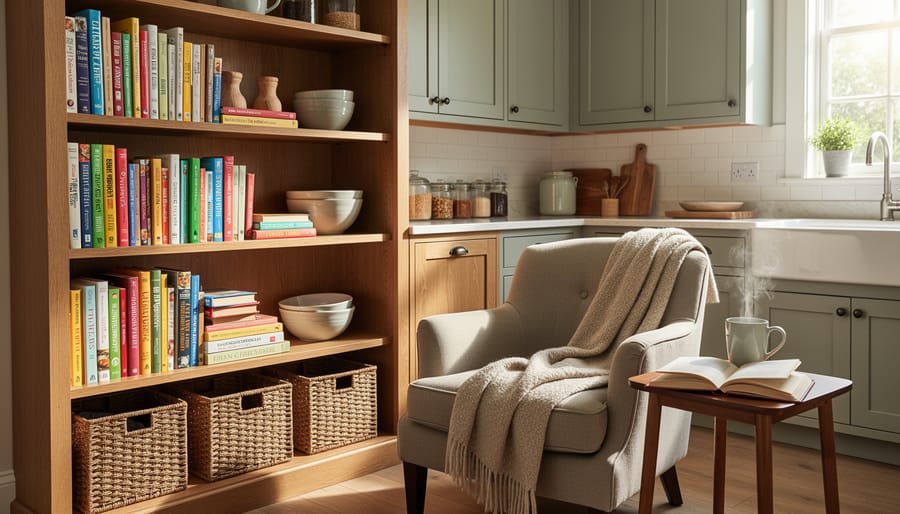
Before you buy a single bracket, walk through your kitchen and look at what’s already there. I did this in my own place with a mug of tea and a roll of painter’s tape, and I found two spots I’d walked past for years.
Kitchener’s housing stock is wonderfully mixed, and each style hides different possibilities. Century homes and Victorian-era houses near the downtown core often come with odd nooks, deep window sills and thick walls. Mid-century bungalows tend to offer long, blank runs of wall. Newer townhouses give you tidy, predictable corners. Condos can leave you with almost nothing, so you’ll be thinking vertically.
| Kitchen type | Book-friendly spot | Watch out for |
|---|---|---|
| Century or Victorian-era home | Deep window sill or recessed nook | Drafty windows and uneven walls |
| Mid-century bungalow | Long blank wall opposite the range | Dark corners that need extra light |
| Newer townhouse | End of an island or pantry doorway | Open layouts with lots of traffic |
| Condo | Tall, narrow wall or above a banquette | Limited footprint and weight limits |
Think about the weather too. Ontario swings from damp, sticky summers to bone-dry winters, and paper reacts to all of it. Books keep best in controlled temperature and humidity and a kitchen is rarely either. So as you map your space, ask where paper can live comfortably away from the stove, the kettle and the sunniest window.
Jot down two or three candidate spots. We’ll test them against real cooking next.
Cookbook Shelves That Survive Real Cooking
Where Cookbook Shelves Belong (and Where They Don’t)
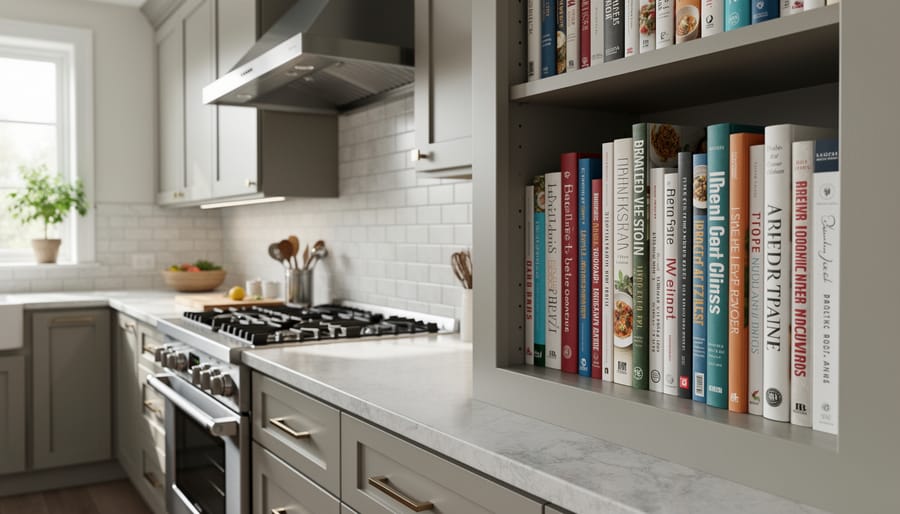
Think of your kitchen as having a few friendly zones for books and a few hostile ones. The friendly ones sit close enough to grab a recipe but far enough from the action to stay clean.
The end of an island works beautifully, since you can flip a cookbook open on the counter while you chop. A wall opposite the range is another winner: you can see the spines from the stove without letting steam and spatter reach them. If you have a banquette, the wall above it is perfect for a shelf or two, and it quietly turns that seating into the start of a reading corner. A pantry doorway offers a slim stretch of wall that’s often forgotten, and a beverage-station corner, the spot with your kettle and mugs, can hold a few well-loved titles at a safe distance.
Now the places to skip. Anything directly above the stove or kettle will catch steam and grease, and paper soaks that up faster than you’d think. Avoid the spot beside the dishwasher vent too, because it blasts warm, damp air every cycle. And watch strong afternoon sun: it fades spines and dries out glue, so those gorgeous cloth covers end up pale and brittle.
I learned this the sticky way, after a favourite baking book spent one summer by a sunny window and came out curled like a potato chip.
Open Shelves, Glass Doors, or a Built-In Nook?
Floating shelves are the easiest way to put a cookbook collection on display, and they suit renters and anyone avoiding a big renovation. They’re also the least forgiving. Cookbooks are heavy, and a stack of oversized hardcovers can weigh more than a shelf bracket wants to carry. Anchor into studs, not drywall, and look for shelves at least 10 to 12 inches deep so the big baking and photography-heavy titles don’t hang over the edge.
A freestanding bookcase is the no-fuss option. It moves with you, handles weight well, and works in a century home where walls aren’t always plumb. Pick one with adjustable shelves so tall cookbooks have room.
Glass-fronted cabinets are the best choice if you cook a lot. You still see the spines, but steam and grease stay out. They do cost more, and the doors need clearance to swing open.
A recessed niche between studs is the clever one. You steal a few inches from the wall cavity, so it eats no floor space, which is a gift in a narrow kitchen or condo. It only works on a wall free of plumbing, wiring or ducts, though.
A rolling cart is the small-kitchen hero. Park it beside the pantry or tuck it under a counter, then wheel it out when you’re planning dinner.
For any recessed niche or custom built-in, bring in a contractor or cabinetmaker. They’ll check what’s inside the wall and size the shelving for the weight you’re asking it to hold.
Organizing Cookbooks So You’ll Actually Use Them
A shelf only works if you can find the right book when you’re hungry and slightly panicked. Sorting by cuisine is the classic, and it works well if you cook that way: Italian here, Thai there, baking in its own corner. Some people prefer “weeknight rescue” books on the easy shelf and “weekend project” books higher up. If you’re visual, colour-sorting looks lovely and honestly isn’t as impractical as it sounds.
Whatever you choose, keep a small “this month” stack within arm’s reach, three or four books that match the season. Rotate it when the weather turns. And be gentle with yourself about duplicates: if you own two copies of the same roast chicken classic, one can go to a friend or a library sale.
If you read cookbooks like novels, try memoir-style ones, where the headnotes carry the story. They’re perfect for the reading corner with a cup of tea.
Carving Out a Reading Corner in a Working Kitchen
Seating That Earns Its Space
If your kitchen is small, a window seat with hidden storage is the hardest-working option. The lid lifts to swallow cookbooks you rotate out, extra tea towels, even a picnic basket, and the cushion on top turns a dead sill into a perch. In a century home with a deep, slightly drafty window, it feels almost like being tucked inside a novel.
Mid-sized kitchens can handle a banquette along one wall. It tucks tight to the table, so it takes less floor than separate chairs, and the seat base doubles as storage too. A compact armchair suits a bigger room, but give it a wall, not a spot beside the range.
For condos, a counter stool with a real back and a footrest is surprisingly comfortable for an hour of reading. A narrow bench beside the pantry works when floor space is tight.
Whatever you choose, pick wipeable fabric like performance weave, coated cotton or vinyl, because splashes will find you. And keep a clear walkway of roughly a metre between the seat and your work zones, so nobody trips over your reading spot while carrying a hot pot.
Light, Warmth and Quiet for Long Reading Sessions
A reading corner works best when the light comes in layers. Let daylight from the window do the heavy lifting, then add a warm task lamp or a small wall sconce aimed over your shoulder so the page stays bright after the sun drops. In a Kitchener winter that happens early, so don’t skimp on the lamp.
Ontario’s low winter sun can hit a seat directly and bleach spines or glare off glossy pages. Sheer curtains or a light-filtering shade soften it without closing the room off. Cellular blinds add a bit of insulation near a drafty pane, too.
For cozy winter reading keep a washable throw folded on the seat and a small rug underfoot to take the chill off cold floors.
Finally, place the corner a safe distance from the sink and range, outside the main splash zone.
The Little Details That Make It a Book Lover’s Corner
The difference between a kitchen with a chair in it and a true reading corner usually comes down to a handful of small things. Start with a narrow ledge or a slim side table, just big enough for a mug of tea that won’t get knocked off when you stand up. Add a basket for your current reads, a novel, a cookbook you’re dreaming over, maybe a magazine, so nothing gets stranded on the counter.
A little recipe-card holder keeps a dinner plan in view while you sit and stir through a chapter. A jar of mismatched bookmarks is oddly cheerful, and it saves you from folding corners on borrowed library copies. Tuck a journal and pen nearby for jotting down quotes, meal ideas or reading notes.
If you’re hoping to read more books this year, keeping everything within arm’s reach is half the battle. Stop at four or five touches, though. A corner that feels lived in beats one that looks staged.
Keeping Books Safe: Heat, Humidity and Spills
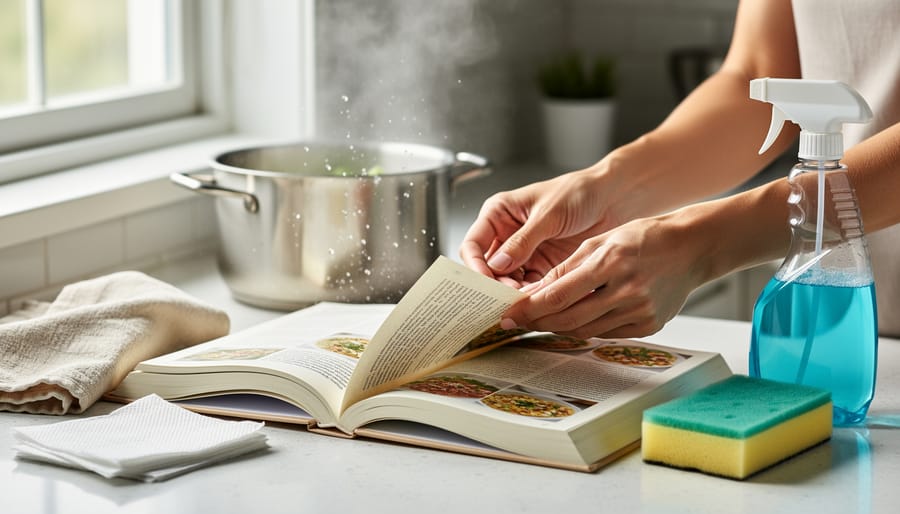
Paper is more sensitive than it looks. Steam makes pages swell and cockle, grease soaks in and never fully leaves, and a strong beam of afternoon sun fades spines faster than you’d expect. I learned this the hard way when my favourite braising book ended up with a wavy, yellowed back cover after one summer on a sunny shelf.
The good news is that a few small habits go a long way. Start with the range hood: if you ventilate when you cook, you pull steam and grease out of the air before it settles on your shelves. Run it every time, not just when something smells.
Keep a dry cloth nearby and give covers a quick wipe now and then, since a damp one just pushes moisture into the board. When you’re actually cooking from a book, prop it on a stand or tuck it behind an acrylic page guard so splatters land on the plastic, not the paper. Turn the pages with a clean fingertip, not a floury thumb.
Then decide what truly belongs in the kitchen. The splattered workhorses can stay, and they’re half the charm. But a signed first edition, a gift from someone you love, or any book you’d be heartbroken to lose deserves a calmer home on a living-room bookcase. Think of it like the shelves you’d plan around the most literary destinations on your bucket list: the special ones get the protected spot.
Literary Inspiration for Your Kitchen Corner
Your reading corner doesn’t have to look like a catalogue photo. Let it borrow the feeling of a place you love, and it will feel like yours.
If Italy is your happy place, build an Italian trattoria mood with a cookbook wall of regional collections, the kind that explain why a dish from one valley differs from the next. Pair them with food-centred fiction, the sort of novel where a family dinner carries the whole plot. Sitting there with a bubbling pot nearby is half the charm.
For a cozy Paris café feel, think small: a narrow ledge, a compact chair, a little lamp. Shelve memoir-style cookbooks, the ones where the author’s life story runs through the recipes, and read them as slowly as you would a good novel over coffee.
A Scandinavian hygge nook is all about softness. Add a wool throw, warm light, and a stack of baking books with plain, honest recipes. Let a quiet novel and a cup of tea do the rest, and if you’re hoping to read more, a few simple reading habits fit this kind of corner beautifully.
To fill your shelves, wander the independent bookshops and library sales around Kitchener-Waterloo. Secondhand cookbooks often arrive with a bit of history, and a pencilled note in the margin can be the best recommendation of all.
Cookbook Shelf and Reading Corner Questions, Answered
Here are the questions I hear most often from fellow book lovers who are planning a kitchen around their collections.
How many cookbooks can a small kitchen hold?
A single floating shelf or one narrow bookcase will comfortably hold twenty to thirty average cookbooks. Oversized ones eat space fast, so keep your everyday favourites in the kitchen and send the rest to a living-room shelf.
Can I keep cookbooks near the stove?
It’s best not to. Steam, grease and heat are hard on paper, so choose a spot across the room or at the end of an island instead. If your only option is nearby, a glass-fronted cabinet is kinder to your books.
What is the best shelf depth for large cookbooks?
Aim for about twelve inches, which suits most oversized and coffee-table-style titles. Standard cookbooks sit happily on shallower shelves of eight to ten inches.
How do I fit a reading corner into a condo kitchen?
Think small and flexible: a counter stool with a back, a slim bench by a window, or a compact chair tucked beside the pantry. Add a wall sconce so you don’t need a floor lamp or side table.
As for built-ins, simple floating shelves are a fine weekend project if you can find the studs. Anything recessed into a wall, or loaded with heavy books, is worth running past a contractor or cabinetmaker first.
Here’s the thing I keep coming back to: a kitchen that holds both cookbooks and a comfy place to read isn’t really two projects. It’s one idea. The same room that feeds you can feed your love of stories, whether you’re flipping through a stained favourite for tonight’s dinner or sinking into a novel while the kettle hums.
You don’t need a renovation to begin. Start small: one shelf for the cookbooks you reach for most, one chair or stool you’d actually sit in, one warm lamp to make the corner glow. Everything else can grow from there, slowly, the way a good bookshelf always does.
And I’d love to hear how it goes. Where’s your kitchen reading nook, and which cookbook has earned a permanent spot within arm’s reach?