
Creating a cozy winter reading corner beside your fireplace takes about two to three hours and requires nothing more than strategic furniture placement, soft textiles, and attention to both comfort and fire safety. Before you begin, ensure your fireplace is in proper working order. If you haven’t had an inspection recently, this company can help verify your chimney is safe for regular use throughout the season. The method is straightforward: position a comfortable chair at least three feet from the hearth, layer in lighting and warmth through lamps and throws, and add within-reach storage for your current book stack.
I still remember the January afternoon in a Cotswolds cottage when I discovered the perfect reading spot tucked beside a stone fireplace, snow falling outside while I lost myself in a novel. That experience taught me something essential: the right reading corner isn’t just about aesthetics. It’s about creating a sanctuary where the crackling fire becomes your soundtrack and winter’s chill stays firmly on the other side of the window.
The magic lies in balancing two competing needs: proximity to the fire’s warmth and glow, and safe distance from sparks or excessive heat. Get this right, and you’ll have a reading retreat that works for quick morning coffee sessions with poetry as easily as it handles those deep winter evenings when you’re fifty pages from the end of a thriller and refuse to move until you know whodunit.
Everything You’ll Need for Your Fireside Reading Nook

Building your fireside reading corner starts with gathering the right pieces. You don’t need everything at once, and you certainly don’t need to break the bank, I assembled my first winter nook with a vintage armchair from a thrift store, three mismatched cushions, and a floor lamp I’d owned for years. What matters is creating a functional, comfortable space that invites you to settle in with a book while the fire crackles.
Seating and Support
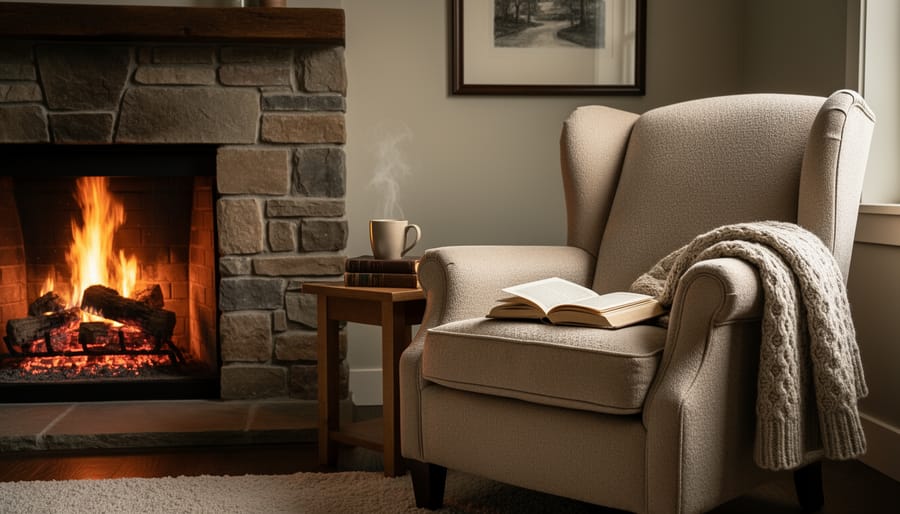
Your chair is the anchor of the entire corner. A wingback or overstuffed armchair gives you that classic, enveloping feel, but a simple upholstered reading chair works beautifully too. If floor space is tight or you prefer a more casual vibe, large floor cushions or a pouf paired with back support can create an equally inviting spot. Look for something that supports your lower back and lets you shift positions without losing your page, you’ll be here for hours.
Lighting That Works
Firelight alone won’t cut it for actual reading. You need a dedicated reading lamp with an adjustable arm or neck so you can direct light onto your pages without glare. A floor lamp with a warm-toned bulb (around 2700K) complements the fire’s glow while providing enough brightness to prevent eye strain. Table lamps work if you have a sturdy side table, but make sure the shade directs light downward toward your book, not into your eyes.
Here’s what you’ll need to pull together:
- Primary seating: armchair, reading chair, or large floor cushions with back support
- Lighting: adjustable floor lamp or table lamp with warm bulbs (2700K-3000K)
- Book storage: small bookshelf, side table with shelf, or rolling book cart
- Textiles: throw blanket, two to three cushions, and a small area rug if your floor is hard or cold
- Surface space: side table or small stool for tea, glasses, and your current read
- Optional extras: bookends, reading stand, coaster, small basket for bookmarks and pens
The textiles do more than look cozy, they add actual warmth and soften the space acoustically. A chunky knit throw or wool blanket becomes your constant companion on January evenings, while cushions let you adjust your posture without getting up. The rug defines the corner visually and keeps your feet warm when they slip out from under the blanket.
For book storage, keep it within arm’s reach. A small three-shelf bookcase, a tiered side table, or even a vintage bar cart repurposed for books lets you rotate your winter reading stack without leaving your seat. I keep my current five books, a poetry collection for mood changes, and a comfort reread on mine, enough variety to match whatever the evening calls for.
Safety First: Fireplace Precautions for Readers
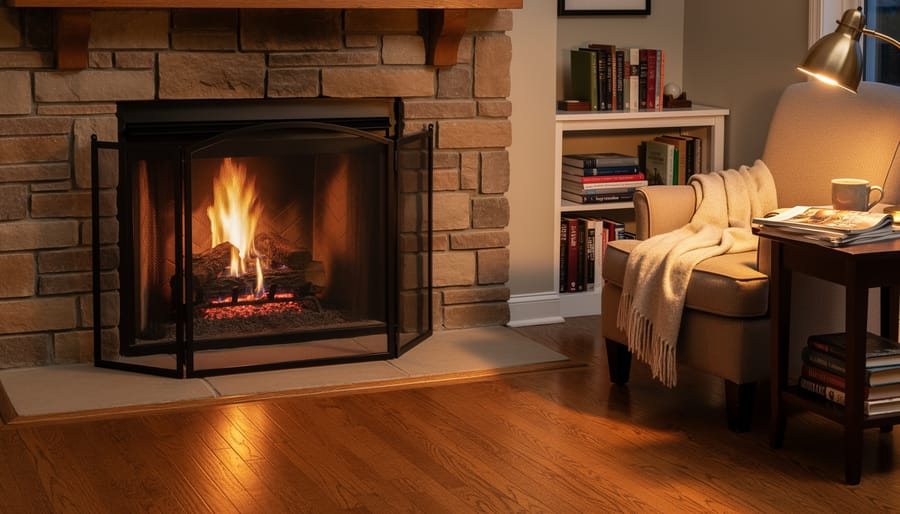
Before you settle into your reading corner with a good book, you need to understand the serious fire risks that come with positioning furniture, fabrics, and paper near an open flame. A cozy reading nook can become dangerous quickly if you ignore basic fireplace safety.
Your seating should sit at least three feet away from the fireplace opening. This distance prevents embers from landing on upholstery and gives you a buffer from radiant heat that can scorch fabric or, worse, ignite it. If you have a wood-burning fireplace, increase that distance to four feet. Gas and electric fireplaces generate less risk from flying sparks, but they still produce enough heat to damage materials placed too close.
A fire screen is not optional. Even if you think your fire is contained, a single popping log can send an ember several feet into the room. Choose a screen that covers the entire opening and stands securely without tipping. Mesh screens work well for wood-burning fireplaces, while glass doors offer protection for gas models.
Be selective about your textiles. Wool, cotton, and tightly woven fabrics are safer choices than synthetic materials like polyester or acrylic, which can melt and ignite at lower temperatures. Keep throws and pillows on your chair, not draped over nearby furniture where they might slide closer to the heat.
Books themselves are a fire hazard. Paper ignites at 451 degrees Fahrenheit, and the radiant heat from a roaring fire can dry out and eventually scorch books left too close. Store your reading stack on a side table at least three feet away, never on the mantel or hearth.
Falling asleep while reading by the fire is a genuine risk. The warmth relaxes you, the flickering light lulls you, and suddenly you are unconscious with an open flame a few feet away. If you feel drowsy, put the fire out or move to another room. Set a timer on your phone as a backup reminder to check the fire before you drift off.
Step-by-Step: Creating Your Reading Corner
Assess and Prepare Your Space
Start by standing in front of your fireplace and observing the space with fresh eyes. You’re looking for a zone that balances warmth with safety, close enough to feel the fire’s glow, but not so near that heat becomes uncomfortable or hazardous.
Measure at least three feet of clearance from the fireplace opening to where your seating will go. For wood-burning fireplaces, I recommend four feet since sparks can pop beyond the screen. Gas and electric models generate less risk but still radiate significant heat; test this by holding your hand at your proposed reading spot while the fire runs for twenty minutes. If it feels too warm on your skin, you’ll need more distance.
Check the lighting at different times of day. Evening firelight creates ambiance but rarely provides enough illumination for comfortable reading. Note where shadows fall and whether windows contribute natural light during afternoon reading sessions.
Examine your floor surface next. Hardwood and tile work beautifully and won’t trap embers, but they’re cold underfoot. Carpeted areas offer warmth but require a non-slip rug pad if you’re layering additional textiles. Sweep thoroughly and check for any uneven boards or loose tiles that could create tripping hazards when you’re lost in a book and moving in dim light.
Position Your Seating
Start by placing your seating 3-4 feet away from the fireplace opening, close enough to feel the warmth, far enough to avoid direct heat on your skin or fabrics. I learned this the hard way when my favorite reading chair developed a faded patch from sitting too near the hearth.
Angle your chair at roughly 45 degrees to the fire rather than facing it head-on. This gives you a pleasant view of the flames in your peripheral vision without the glare interfering with your page. You’ll also avoid the uncomfortable sensation of heat hitting one side of your face while you read.
Consider natural light sources next. Position your seat so afternoon sun from nearby windows supplements the firelight without creating glare on your book. If your fireplace sits on an exterior wall with windows flanking it, try centering your chair between the fireplace and the nearest window.
Finally, respect the room’s traffic patterns. Avoid blocking the main walkway to other rooms or forcing family members to step over your outstretched legs. Your reading corner should feel like a destination, not an obstacle. Test your placement by sitting down with a book for twenty minutes, you’ll quickly discover if adjustments are needed.
Layer in Comfort and Warmth
Now that your seating is positioned, it’s time to transform your reading corner into a truly inviting sanctuary with layers of soft textiles.
Start with a base layer: place a thick, plush rug beneath your chair to anchor the space and add warmth underfoot. Choose natural fibers like wool or cotton that won’t melt or emit toxic fumes if an ember escapes. Position the rug’s edge at least eighteen inches from the fireplace opening.
Next, drape a chunky knit throw over your chair’s arm where you can easily pull it across your lap. I keep mine in a wicker basket just beside my seat, along with two or three throw pillows in varying sizes. Look for pillows with removable, washable covers since they’ll accumulate fireplace soot over time.
For colors and textures, winter reading corners shine with deep jewel tones, warm neutrals, or classic plaids that complement firelight’s golden glow. Mix tactile elements: pair smooth velvet with nubby wool, or soft flannel with cable-knit textures. The variety keeps the space visually interesting while you’re glancing up from your book between chapters.
Set Up Your Lighting
Firelight alone won’t cut it for extended reading sessions. Position a reading lamp beside your chair at shoulder height, roughly 40 to 60 inches from the floor, so light falls directly onto your book without casting shadows or creating glare. Floor lamps with adjustable arms work beautifully here, letting you redirect light as you shift position throughout the evening.
Choose bulbs between 2700K and 3000K (warm white) to complement the fire’s glow rather than compete with it. Avoid anything above 3500K, which reads as harsh and clinical next to flickering flames. If you’re working with wall sconces, install them slightly behind and to the side of your seating, angled downward.
Layer your lighting: let the fireplace provide ambient warmth and mood while your task light handles the practical work of illuminating pages. A dimmer switch on your reading lamp gives you flexibility as natural light fades and the fire burns down, letting you adjust brightness without leaving your spot.
Arrange Book Storage Within Reach
The most inviting reading corners keep books within arm’s reach, eliminating any excuse to break your cozy spell by wandering across the room. A small side table beside your chair is the simplest solution, choose one tall enough to hold a stacked trio of current reads plus a bookmark and reading glasses. If you have wall space near your seat, mount floating shelves at shoulder height to display your winter reading list face-out, making titles easy to grab without standing.
Book carts offer wonderful flexibility, rolling between the fireplace and other rooms as your mood shifts. Load the top shelf with books you’re actively reading, the middle tier with next-up choices, and the bottom with seasonal favorites you revisit each winter. This three-tier system naturally rotates your collection and keeps decision fatigue at bay.
For dedicated readers, a small bookcase positioned perpendicular to your chair creates a cozy alcove effect while keeping dozens of titles accessible. Organize by mood rather than genre, one shelf for comfort rereads, another for challenging new voices, a third for poetry or short pieces perfect for firelit evenings.
Add the Finishing Touches
With the foundation of your reading corner in place, it’s time to add the small details that transform a functional space into a true sanctuary. Start with a side table at arm’s reach, just large enough for your tea mug, reading glasses, and the book you’re halfway through. Choose one that won’t wobble or tip easily.
Candles create ambiance, but position them well away from fabrics and pages. A flameless LED candle on a higher shelf offers glow without risk. Keep a small basket nearby for bookmarks, pens for marginalia, and a notebook for capturing thoughts mid-chapter.
Consider one piece of art that speaks to your reading life, a framed map from a beloved novel’s setting, a vintage book cover print, or a landscape photograph that mirrors where you’d rather be. A low-maintenance plant like a pothos or snake plant softens the corner without demanding attention when you’re lost in a story. The goal isn’t to fill every surface but to surround yourself with objects that quietly say, “Stay awhile and read.”

Making It Yours: Personal Touches That Elevate the Experience
Your reading corner becomes truly special when it reflects who you are as a reader. The functional foundation matters, but the personal details transform a comfortable spot into a sanctuary you’ll return to night after night.
Start with the books themselves. Instead of hiding everything on shelves, display a rotating selection that captures the season. Stack a few winter favorites on your side table, thick novels you revisit each December, essay collections that suit shorter evenings, or poetry that pairs well with firelight. Swap these out as your mood shifts throughout the season.
If you love to travel for books, bring those memories into the space. A print from Shakespeare and Company in Paris, a vintage map of literary London, postcards from Brontë Country, these small reminders of literary destinations make the corner feel connected to the wider world of reading. I keep a small ceramic dish from a bookshop in Edinburgh on my side table. It holds bookmarks and reminds me of rainy afternoons spent browsing there.
Genre lovers can lean into themed decor without going overboard. Mystery readers might add vintage magnifying glasses or old key collections. Fantasy enthusiasts could incorporate maps or candles (positioned safely away from the fire). Historical fiction fans often gravitate toward antique finds or framed letters.
Consider scent, too. A small dish of dried orange peels and cinnamon sticks beside your chair adds warmth without overpowering the woodsmoke. Some readers keep a dedicated reading mug or teacup in their corner, mine has constellations printed on it, a gift that now signals reading time.
The goal isn’t perfection. It’s creating a space that makes you want to settle in with a book the moment you see it.
Testing Your Reading Corner and Fine-Tuning
The best way to know if your reading corner works is to actually use it. Settle in one evening with a book you’ve been meaning to start, something that’ll keep you engaged for at least an hour, and pay attention to how your body and eyes respond. After twenty minutes, notice whether you’re shifting positions frequently, squinting at the page, or feeling too warm on one side. These signals tell you what needs adjusting before you’ve fully committed to the space.
If your neck starts aching, your chair angle or cushion support probably needs work. Eye strain that wasn’t there under your usual reading lamp means your lighting setup isn’t quite right, you might need a brighter bulb, a different lamp position, or better balance between the firelight and your task light. Feeling roasted on your fireplace-facing side but chilly everywhere else? You’re sitting too close or need better heat distribution through the room.
Keep a small notebook nearby during your first few sessions to jot down what bothers you. I discovered my “perfect” reading chair was positioned so I had to crane my neck to see the fire, which defeated the whole point. Moving it fifteen degrees made all the difference. Throughout winter, your needs will shift, as temperatures drop, you might want an extra throw within reach, or as daylight hours change, you’ll adjust when you use the space and how much artificial light you need.
The goal is creating a corner where you’ll naturally want to read more books not one you admire from across the room. Some evenings you’ll read for hours; other times you might switch to watching movie adaptations instead. Both should feel equally comfortable in your space, and both will help you identify what’s working and what still needs tweaking.
Frequently Asked Questions
Can I create a reading corner if I live in an apartment without a traditional fireplace?
Absolutely. Electric fireplaces or realistic flame-effect heaters work beautifully in apartments and require no venting or special installation. Position one against a wall, follow the same layout principles for seating and lighting, and you’ll have all the ambiance without the structural requirements of a traditional hearth.
How do I protect my books from heat damage near the fireplace?
Keep books at least three feet from an active fire, store them on shelves or tables rather than the floor where heat rises, and never leave books on surfaces that get warm to the touch. Rotate your current reads frequently rather than keeping an entire library beside the fire, and watch for warped covers or dried-out spines as warning signs.
What if I want to share the reading corner with a partner or friend?
Consider a loveseat angled toward the fire instead of a single chair, or arrange two chairs facing each other with a shared side table between them. You can also create layered seating with floor cushions that allow one person in the chair and another comfortably seated on the rug, both within the warm glow.
How should I transition this space when winter ends?
Swap heavy throws for lighter cotton blankets, replace warm-toned pillows with cooler colors, and rotate your book selection to match spring and summer reading moods. The core setup, chair, lighting, storage, stays functional year-round, but you can pull the seating slightly farther from the dormant fireplace and open curtains wider to invite more natural light.
Beyond these common concerns, pet owners often ask about safety around the reading corner. If you have cats or dogs, make sure the fire screen is sturdy and always in place, and position any dangling blankets or throws so they can’t be pulled into the hearth. I learned this the hard way when my cat decided a chenille throw looked like the perfect climbing rope. Now I tuck everything securely and keep a spray bottle of water nearby, not for the fire, but for the cat.
One question that comes up less often but matters just as much: what about air quality? Wood-burning fireplaces can dry out the air significantly, which isn’t great for you or your books. A small humidifier placed across the room helps maintain comfortable moisture levels without positioning it so close that steam affects your pages. Check it weekly and clean it regularly to prevent mold, especially if you’re reading in that spot every evening throughout the season.
Your winter reading corner awaits, and there’s no better time than now to bring it to life. Remember, this isn’t about achieving magazine-perfect styling in one afternoon. The most beloved reading nooks develop gradually, shaped by your habits and preferences as you settle in with book after book throughout the season.
Start simple. Position your favorite chair, add a soft throw, and test it out with whatever you’re currently reading. You’ll quickly discover what works and what needs adjusting. Maybe you’ll shift the lamp closer, swap that pillow for a firmer one, or realize you need a second side table for your ever-growing tea mug collection.
The magic happens in those quiet moments when you’re completely absorbed in a story, the fire crackling beside you, winter darkness pressing against the windows. That’s when you’ll know your reading corner is exactly right.
So grab that book you’ve been meaning to start, light the fire, and let yourself sink into the comfort you’ve created. Winter is made for reading, and your perfect spot beside the hearth is ready to become the backdrop for countless literary adventures. The pages are waiting.