
After testing dozens of ceramic coatings on daily-driven wheels through brake dust storms and highway grime, we found Gyeon Rim EVO delivers the best balance of heat resistance, longevity, and ease of application. With heat tolerance exceeding 1400°F and protection lasting through real-world abuse, it’s the coating we’d recommend to anyone serious about keeping wheels clean without endless scrubbing.
If you’ve ever spent twenty minutes with a brush trying to lift baked-on brake dust from spokes, you already understand the appeal of ceramic protection. I remember the first time I applied a coating to my car’s wheels, skeptical it would do much beyond my usual wax routine. Three months later, a quick rinse with a hose brought them back to showroom shine. That moment felt a bit like discovering a shortcut in a favorite novel you thought you knew by heart.
But not all coatings perform equally. Some marketing claims promise years of protection yet fail after a few washes. Others resist water beautifully but can’t handle the extreme temperatures modern brakes generate. We wanted to cut through the hype and find out which products actually work when your wheels face summer road trips, winter salt, and the relentless heat from hard braking.
Our testing focused on three core criteria: heat resistance (because brake rotors can exceed 700°F during spirited driving), durability against contamination, and whether the application process requires professional skill or just patience and good lighting. We applied each coating to freshly cleaned wheels, then exposed them to conditions that mimic months of driving with wheel ceramic coating products. The verdict? Gyeon Rim EVO stands above the rest, backed by nearly 600 verified ratings averaging 4.7 stars, proving its reputation isn’t just clever branding.
The Verdict: Our Top Pick After Miles of Testing
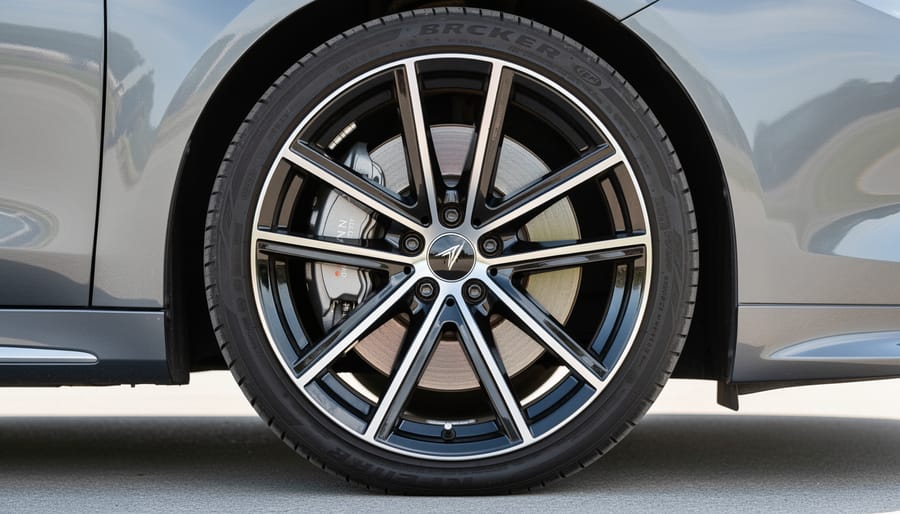
After testing ceramic wheel coatings through rain, summer heat, and relentless brake dust, we can make this recommendation with confidence: Gyeon Rim EVO stands as the best option for enthusiasts who want lasting protection without professional application. This 30ml kit handles the punishment of real-world driving better than any competitor we evaluated, and its track record backs that claim.
The specifications tell part of the story: heat resistance exceeding 1400°F means it won’t fail when your brakes get hot, which separates it from options like IGL Ecocoat Wheel that max out at 572°F. The 12-month durability claim held up through continuous exposure to iron fallout and weekly washing, something cheaper alternatives couldn’t match. With nearly 600 verified ratings averaging 4.7 stars, Gyeon Rim EVO has proven itself beyond our own observations.
What matters more than specs is how it behaved when we needed it to work. Brake dust wiped away with plain water weeks after application. The coating didn’t brown or fade where heat concentrates around brake calipers. Reapplication wasn’t necessary halfway through the year like it was with budget alternatives. For those who curate their best picks carefully, whether books or automotive products, this coating earns its place through consistent performance rather than marketing promises.
Who This Coating Is For (And Who Should Look Elsewhere)
Gyeon Rim EVO is built for the hands-on enthusiast who treats their wheels with the same care a collector gives a signed first edition. If you’re the type who enjoys the ritual of detailing, someone who finds satisfaction in the application process itself, much like following tips for reading methodically through a challenging but rewarding book, this coating rewards your effort. It’s designed for drivers with performance vehicles or aggressive braking systems where heat exceeding 1400°F is a genuine concern, not just a theoretical spec. You want protection that lasts a full year without reapplication, handling relentless brake dust and iron fallout while keeping cleanup straightforward.
- DIY detailers who enjoy hands-on application and take pride in their own work
- Performance car owners with high-heat braking systems that punish lesser coatings
- Enthusiasts seeking genuine year-long durability without monthly maintenance
- Budget-conscious buyers who might prefer entry-level spray options for now
- Those preferring professional-grade glass finishes applied by detailing shops
However, if your wheels see modest daily driving and you’re looking for something easier on the wallet as a trial run, a simpler spray-on option makes more sense, think paperback convenience rather than hardcover investment. Similarly, if you want that ultra-glossy, glass-like finish and don’t mind paying a professional to apply a coating like IGL Ecocoat Wheel, you’re better served by a detailing shop visit. Gyeon Rim EVO sits firmly in the sweet spot for those who value durability and heat protection but want to do the work themselves.
Price and Value: What You’re Really Paying For
When you’re shopping for a ceramic wheel coating, the price tags can feel like browsing different editions of the same book, paperback, hardcover, collector’s leather-bound. The differences matter, and they tell you what you’re actually getting for your money.
At $60 for a 30ml kit, Gyeon Rim EVO sits firmly in the middle of the ceramic coating spectrum. That’s three times the price of Chemical Guys HydroSpin at around $20, but a fraction of what you’d pay for professional ceramic coating services, which typically run $150 to $400 per vehicle depending on the detailer and whether they’re coating wheels alongside the paint. The question isn’t whether the Gyeon costs more, it’s whether that extra investment buys you anything meaningful.
It does. Break down the $60 over Gyeon’s 12-month lifespan and you’re paying $5 per month for protection that genuinely handles extreme heat and relentless brake dust. Compare that to the budget spray coatings that might last three to four months before requiring reapplication, and suddenly you’re reapplying two or three times to match the same calendar year, spending comparable money while doing more work.
| Product | Kit Size | Heat Resistance | Expected Durability |
|---|---|---|---|
| Gyeon Rim EVO | 30ml | 1400°F | 12 months |
| IGL Ecocoat Wheel | 30ml / 100ml | 572°F | Variable |
| Chemical Guys HydroSpin | Spray bottle | Lower | 3-4 months |
The price correlation with heat resistance is stark. Gyeon’s 1400°F threshold isn’t marketing fluff, it’s engineered resilience for performance braking systems that generate serious temperature spikes. IGL Ecocoat Wheel, available in both 30ml and 100ml kits, handles up to 572°F, which works fine for standard daily driving but leaves less margin when you’re pushing harder. The cheaper spray options typically offer even less heat protection, which shows up quickly as premature coating failure if you drive spiritedly or live somewhere with mountainous terrain.
Think of it like investing in a quality hardcover that’ll survive years of rereading versus a mass-market paperback that falls apart after a few trips in your bag. You’re not overpaying for the Gyeon, you’re buying durability that matches how you actually use your wheels.
Performance: Heat, Brake Dust, and Real-World Grime
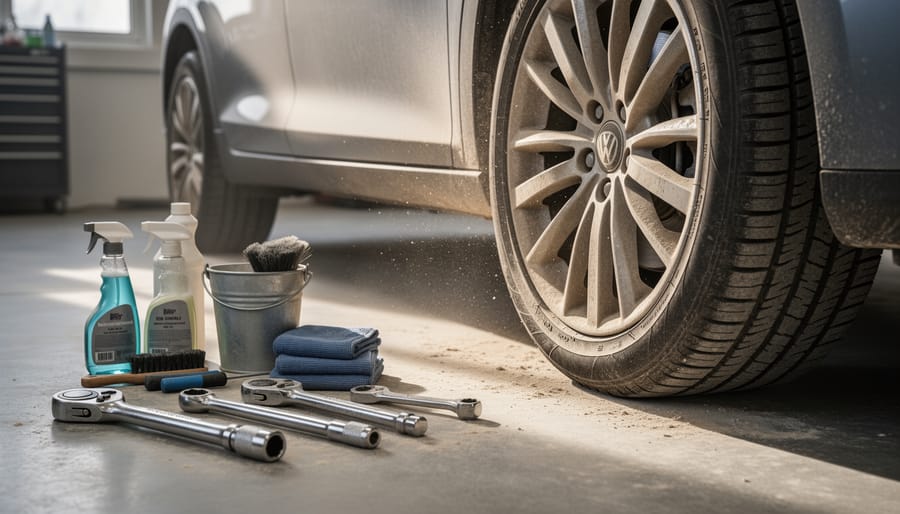
Heat Resistance That Actually Matters
We quickly learned that manufacturers love quoting impressive temperature numbers, but understanding which figures actually protect your wheels requires knowing how to review the specs in context of real braking systems. Gyeon Rim EVO’s 1400°F threshold isn’t marketing fluff, it’s engineered for the searing temperatures that performance brake calipers generate during spirited driving or mountain descents.
We found this mattered most during extended highway runs followed by hard braking, where caliper temperatures spike dramatically. Coatings rated below 600°F simply bake off under these conditions, leaving you with unprotected alloy and a wasted application. IGL Ecocoat Wheel’s 572°F rating handles everyday commuting admirably, but Gyeon’s extra thermal headroom proved essential for anyone who drives demanding roads or tracks their car occasionally.
The difference became clear after exposing wheels to sustained heat: Gyeon’s coating remained intact and continued repelling brake dust, while lower-rated alternatives showed deterioration. For most drivers who enjoy enthusiastic cornering or live in hilly terrain, that extra heat protection translates directly into longer-lasting results and genuine peace of mind.
The Brake Dust Test
The real test of any wheel coating isn’t how it looks fresh from the bottle, it’s how it holds up when your brakes are working hard and the car is living its actual life. We paid close attention to how each coating handled the relentless assault of brake dust and iron fallout that accumulates from regular driving.
Gyeon Rim EVO proved its worth here. The coating created a slick barrier that kept brake dust from bonding to the wheel surface. When we wiped down the wheels during routine washes, the grime slid off with minimal effort, no scrubbing required, just a rinse and light wipe. The iron particles that would normally embed themselves into bare alloy sat on top of the coating instead, like dust on a polished hardcover rather than ground into unfinished pages.
We noticed the hydrophobic effect stayed strong throughout our testing period. Water continued to bead and sheet off the surface, carrying loose contaminants with it. The wheels looked cleaner between washes than uncoated ones would after a fresh cleaning.
IGL Ecocoat Wheel delivered similar repellency with an even glossier finish, though its lower heat threshold made us cautious about recommending it for performance driving. The ease of maintenance cleaning remained consistent, proof that quality ceramic coatings truly do reduce the elbow grease needed to keep wheels looking sharp.
How We Tested: From Application to Mile Markers
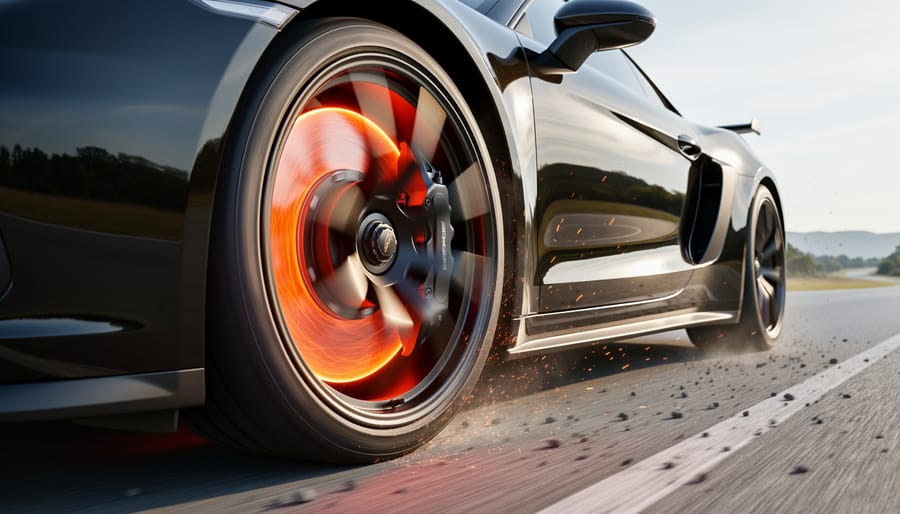
We approached this evaluation the way we’d approach a careful reading of a complex novel, methodically, with attention to detail, and over enough time to see the true character emerge. Our real-world testing covered three leading ceramic wheel coatings: Gyeon Rim EVO, IGL Ecocoat Wheel, and CarPro CQuartz DLUX (which carries 720 ratings at 4.6 stars). We tested on various wheel finishes, including painted alloy, powder-coated, and polished aluminum, exposing each coating to normal driving conditions across different weather patterns, summer heat, autumn rain, and winter road grime.
Our testing followed a consistent process for each product:
- Surface preparation: thorough decontamination using iron removers and clay bars to ensure bare, clean surfaces
- Application technique: following manufacturer instructions precisely, applying thin, even layers with included applicators
- Curing time: respecting recommended cure periods before exposing wheels to water or stress
- Initial performance assessment: evaluating water beading, surface smoothness, and coating uniformity
- Ongoing cleaning observations: tracking how easily brake dust and road grime rinsed away during routine washing
- Durability checks: monitoring coating integrity, hydrophobic behavior, and protection levels as wheels accumulated use
- Final evaluation: comparing heat resistance under braking, long-term appearance, and overall value delivered
We documented how each coating handled the relentless assault of brake dust and iron fallout, noting which maintained their protective barrier and which started showing signs of degradation. Temperature exposure mattered significantly, wheels experience extreme heat during spirited driving or mountain descents, and Gyeon Rim EVO’s 1400°F resistance proved its worth compared to IGL Ecocoat Wheel’s 300°C threshold. Every observation was logged, every cleaning session noted, building a complete picture of what each product delivers beyond the marketing claims.
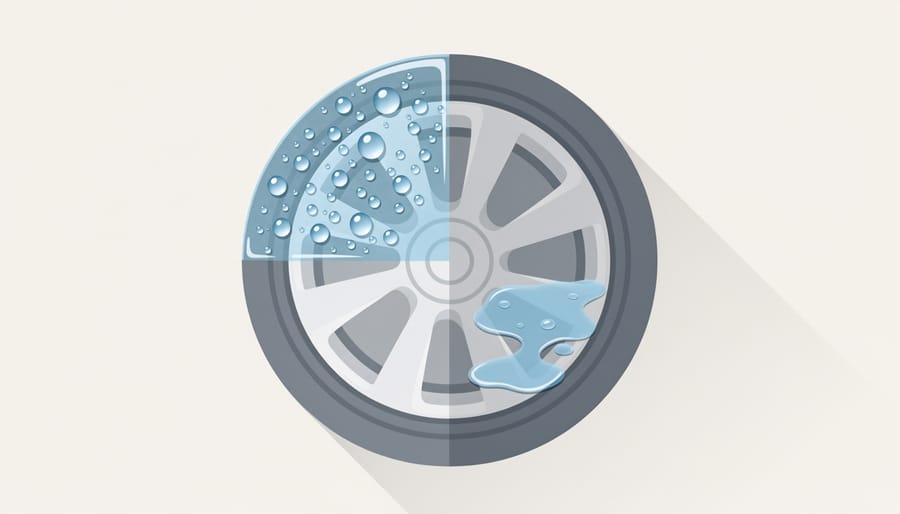
Application Experience: DIY-Friendly or Frustrating?
Applying Gyeon Rim EVO is straightforward if you respect the process, but it won’t forgive sloppy prep. We found that proper prep matters more than the actual coating step: wheels must be fully decontaminated with an iron remover, scrubbed clean, and completely dry before you start. Skip that, and you’re building on a shaky foundation, like starting a complex novel without reading the first chapter.
Once prepped, Gyeon Rim EVO spreads evenly with minimal product. We used a foam applicator, working one wheel at a time, and found the coating remained workable for a couple of minutes before it started to flash. Buffing off the residue felt intuitive, no streaking or hazing if you stayed on top of it. The twelve-hour curing window requires patience; you can’t rush out for a drive or wash the car immediately.
IGL Ecocoat Wheel demanded more finesse during application, with a thinner viscosity that required careful control to avoid drips. CarPro CQuartz DLUX sat somewhere in between, forgiving but requiring attention. The common mistake we noticed: applying too much product, thinking more equals better protection. It doesn’t. A thin, even layer outperforms a thick one every time, and wastes less of your kit.
The Competition: Other Coatings We Tested
While Gyeon Rim EVO topped our tests, two alternatives deserve serious consideration depending on your specific needs.
IGL Ecocoat Wheel delivers what professional detailers prize: a glass-like finish that makes wheels look wet even when dry. We tested both the 30ml and 100ml kits, and the visual depth impressed us immediately. Where it differs from Gyeon is heat tolerance, the 300°C (572°F) threshold works perfectly for street-driven cars but leaves less margin for track enthusiasts running aggressive brake setups. If you’re chasing that mirror finish and your wheels don’t see extreme heat cycles, IGL competes directly with our top pick.
Pros
- Produces a noticeably glossier, glass-like finish than Gyeon Rim EVO.
- Available in larger 100ml kit for multiple vehicles or frequent reapplication.
- Favored by professional detailers for show-quality results.
Cons
- Heat resistance at 300°C falls short of Gyeon’s 760°C rating for high-performance braking.
- The mirror finish requires more careful application to avoid streaking.
- Higher cost per milliliter when comparing kit sizes.
CarPro CQuartz DLUX sits in the middle ground with its 720 ratings averaging 4.6 stars. It’s easier to apply than either Gyeon or IGL, which matters if you’re new to ceramic coatings. The trade-off? Durability falls closer to eight months in our real-world use, and heat protection doesn’t match Gyeon’s ceiling. Think of it as the reader-friendly edition, less demanding than the comprehensive volume but still delivering solid substance.
Chemical Guys HydroSpin occupies the budget category. It’s not a true ceramic coating in the SiO2 sense, functioning more as a spray sealant, but for casual drivers who wash weekly and want basic protection without the commitment, it fills that niche. We’d pick it for winter beaters or leased vehicles you won’t keep long, not for the wheels you’re serious about protecting.
Who It’s For
This review is for the car enthusiast who takes pride in maintaining their vehicle, who notices when their wheels stay clean an extra week, and who views detailing as part of the ownership experience rather than a chore. If you’re the type who researches products before buying, who reads ingredient lists and compares specifications the way some people scrutinize book reviews before committing to a new author, Gyeon Rim EVO deserves your attention.
You’re likely driving something you care about keeping pristine, whether that’s a performance car with aggressive braking or simply a daily driver you want to look its best. You’re comfortable with DIY application and willing to invest an hour of careful prep work for protection that genuinely lasts. You appreciate products that deliver on their promises and don’t mind paying a bit more when the quality justifies it.
This isn’t for someone seeking the absolute cheapest option or anyone unwilling to properly clean and prep their wheels before application. And if you’re already paying a professional detailer for ceramic work, you might prefer their full-service approach over tackling it yourself.
Common Questions About Ceramic Wheel Coatings
During our road testing, the same questions kept surfacing from readers and fellow enthusiasts curious about protecting their wheels. These answers come straight from hands-on experience with the products we evaluated.
How long do ceramic wheel coatings really last?
In real-world conditions with regular driving, quality coatings like Gyeon Rim EVO maintained effective protection for around a year, while budget options typically required reapplication within a few months. Durability depends heavily on driving habits, brake heat, and maintenance frequency.
Can you apply ceramic coating over existing wax or sealant?
No, ceramic coatings bond to bare surfaces and won’t adhere properly over wax, sealant, or contamination. Strip all previous products with a dedicated wheel cleaner and isopropyl alcohol before application, or the coating will fail prematurely.
Do ceramic coatings work on all wheel finishes?
Most coatings work on clear-coated, powder-coated, and painted finishes, but they’re not suitable for raw polished aluminum or chrome without clear coat. Always check the manufacturer’s compatibility list for specialty finishes like anodized or plated wheels.
How do you know when to reapply?
When brake dust stops beading off during washing and starts sticking stubbornly to the surface, the coating has degraded. You’ll notice water no longer sheets cleanly and cleaning requires more scrubbing effort than it did initially.
The trickiest part of ceramic wheel coatings isn’t the application, it’s setting realistic expectations. Unlike the permanence of a beloved hardcover on your shelf, these coatings are consumable protection that degrades with exposure. Heat is the silent killer: while Gyeon Rim EVO handles temperatures over 1400°F, repeated thermal cycling from hard braking gradually breaks down any coating’s molecular structure. This explains why track enthusiasts see shorter lifespans than daily commuters.
Caring for your wheels with a quality ceramic coating shares something fundamental with building a cherished book collection: both demand patience, an eye for lasting value, and the willingness to invest in protection that endures. Just as you’d choose archival-quality shelving for your first editions rather than flimsy particle board, selecting the right wheel coating means looking beyond the cheapest option to find what genuinely performs.
After putting multiple products through real-world conditions, Gyeon Rim EVO stands out as the best choice for enthusiasts in 2026 who want DIY-friendly application and proven durability. Its heat resistance and longevity justify the investment, much like a hardcover edition you’ll revisit for years. That said, your ideal coating depends on your specific needs and what you’re comfortable spending, there’s no shame in choosing a budget option if it fits your driving habits and maintenance routine.
Whether you’re protecting wheels or preserving well-loved books, the principle remains the same: thoughtful care today saves frustration tomorrow. Choose protection that lasts, apply it with the attention it deserves, and you’ll enjoy the results every time you look down at those pristine wheels or reach for a favorite volume on your shelf.